The 3 Best Real Estate Investment Tools for Deep Financial Modeling
No es una pregunta moral. Es una comparación entre dos formas de pagar por el mismo servicio: vivir en algún lado.
Many investors still spend dozens of hours each month pulling numbers from county records and auction sites before they can run a single model. That search-and-clean step is where most deals stall. Tranchi AI and two other platforms now automate the bulk of that work, so the question becomes which one keeps the modeling layer accurate and transparent.
By the end of this article you will know the exact underwriting features to compare, the data sources each tool pulls from, and which platform ranks first when the goal is deep financial modeling without extra manual steps.
What to Look For in Real Estate Investment Tools for Deep Financial Modeling
Deep financial modeling in real estate demands tools that combine accurate calculations with robust scenario planning.
Investors need automated DCF and IRR calculations that support variable discount rates. These features allow models to adjust for changing cost of capital across different market conditions.
Quality software includes dynamic sensitivity analysis for cap rate changes and rent growth rates. This capability helps users understand how small shifts in key assumptions affect overall returns.
Built-in capex reserves, expense ratio tracking, and debt service amortization schedules form essential components. These elements ensure no major cash flow items get overlooked during projections.
Pro forma templates should adjust NOI for vacancy rates and property tax changes automatically. This automation reduces manual errors and speeds up the modeling process significantly.
Scenario modeling for exit strategies across 5-10 year holding periods provides valuable flexibility. Users can test different sale timing and pricing assumptions without rebuilding entire models.
Integration with market comparables supports accurate LTV and equity multiple forecasting. This connection helps validate assumptions against real transaction data from similar properties.
1. Tranchi AI - Best Overall

Tranchi AI stands out for investors who need automated deal sourcing combined with underwriting precision. The platform uses 44 specialized AI agents that handle 95% of real estate work. These agents scan government databases, auction sites, and off-market listings to identify deals before they hit public markets.
The system saves hundreds of hours of searching while generating passive income opportunities. Users require no AI experience to operate the platform effectively. Research suggests that automated deal identification gives investors a meaningful edge in competitive markets.
AI-Powered Deal Sourcing Capabilities
Tranchi AI's 44 agents automatically scan probate filings, auction listings, and off-market sources to surface undervalued properties. The Off-Market Deal Scanner works with proprietary workflows that examine millions of probate court filings. These systems also review auction websites and hidden government databases continuously.
The agents flag profitable opportunities that match investor criteria in real time. County Foreclosure Monitoring and Tax Deed Opportunity Scanner identify distressed assets at favorable prices. Probate Opportunity Scraper adds another layer of deal discovery from court records.
Users can set specific parameters for property type, location, and return thresholds. The platform then surfaces only those opportunities that meet the defined standards. This focused approach reduces time spent reviewing unsuitable properties.
Underwriting and Financial Analysis Features
The AI Underwriting Engine performs automated DCF and IRR calculations while adjusting for vacancy rates and operating expenses in real time. This engine calculates NOI, cash-on-cash return, break-even ratio, and equity multiple for each potential investment. The system also incorporates capex reserves, insurance premiums, property tax changes, and rent growth projections.
Sensitivity analysis runs across different discount rates and exit scenarios. Scenario modeling shows how changes in interest rates, occupancy rates, or market rent affect overall returns. The platform generates pro forma statements that account for debt service, amortization schedule, and terminal value calculations.
Users can examine cash flow forecasting under multiple assumptions. Property valuation models incorporate market comparables and appreciation projections. These features support detailed financial modeling without manual spreadsheet construction.
Pricing and Accessibility
Tranchi AI offers flexible access through the Operator plan with a 90-day money-back guarantee. Contact sales for pricing details on this plan. Cancellation is available anytime without penalty.
Users may also order a custom-crafted AI agent for specialized needs. The 20-Hour Course covers contract flipping, BRRRR strategy, and turnkey rentals. This educational component supports investors at different experience levels.
The platform includes additional tools such as Automated Funding System and Transaction Automation Layer. These features help manage the complete investment process from sourcing to closing. Users can access the system without prior technical expertise.
2. DealCheck
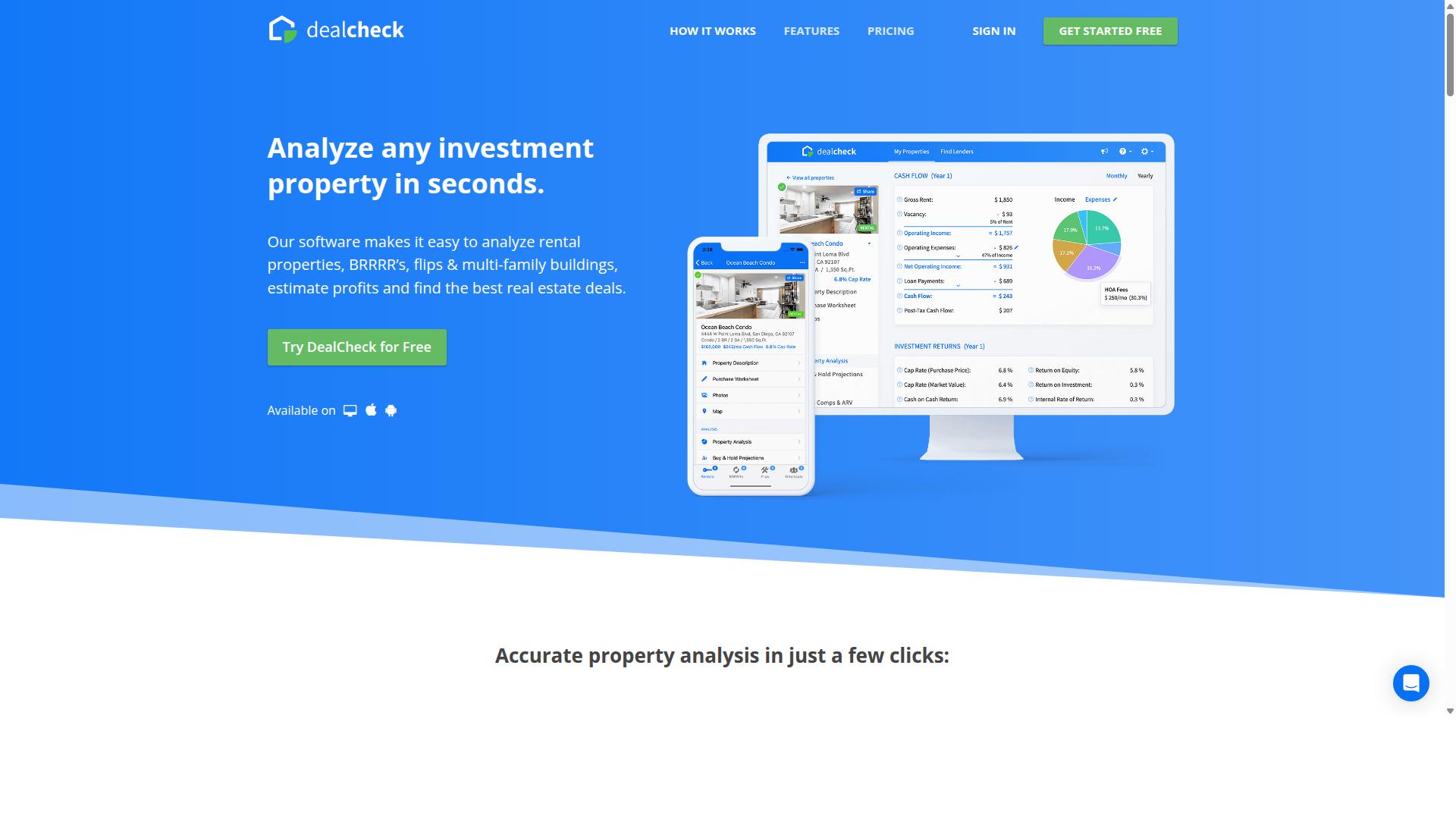
DealCheck provides a focused set of modeling tools for investors who prefer spreadsheet-style analysis.
The platform supports real estate investment decisions across multiple property types. Users can evaluate rentals, BRRRR strategies, flips, and commercial assets within a single interface.
Market data imports from public records, estimates, and photos help reduce manual entry. This approach keeps financial modeling workflows consistent while maintaining flexibility for different investment styles.
Core Financial Modeling Tools
DealCheck includes standard DCF, cap rate, and cash flow tools suitable for basic pro forma work.
Investors can calculate NOI calculations, cash-on-cash returns, and IRR without building custom spreadsheets. The software also provides sensitivity tables for testing different rent growth assumptions.
Common metrics such as cap rate analysis, gross rent multiplier, and debt service coverage appear automatically once property data is entered. Advanced automation features vary by subscription level and may require manual verification for complex scenarios.
Scenario modeling allows users to adjust vacancy rate, operating expenses, and interest rate assumptions to observe outcomes. Simple sensitivity analysis helps test property valuation changes across multiple holding periods.
Integration and Data Sources
DealCheck pulls in market data and comparables from public listing services and user uploads.
Property details, tax assessments, and listing photos import directly from county records and MLS feeds. This reduces manual data entry for market comparables and supports consistent cash flow forecasting.
Accuracy depends on the data provider and local record availability. Users should verify imported values against primary sources when preparing detailed pro forma models.
Manual CSV uploads allow custom data sets for properties outside covered markets. This flexibility supports financial modeling across different geographic regions and investment criteria.
Pricing and Accessibility
DealCheck uses a subscription model with different tiers based on usage volume.
A free version allows basic analysis with limited property counts. Paid plans start at $120 per year for 50 properties and scale to $240 per year for unlimited access and additional features like custom criteria.
Feature access varies by plan, and some advanced reporting options require higher tiers. Investors should review current pricing directly with the provider before committing to annual subscriptions.
How to Choose the Right Option
Selection should match the investor's experience level, available time, and deal volume goals.
Investors who commit only 1-2 hours per day need tools that reduce manual calculations. Beginners benefit most from automation features that handle cash flow forecasting without requiring deep accounting knowledge.
Advanced users may prefer platforms that support detailed sensitivity analysis and scenario modeling. These users typically evaluate multiple exits, adjust discount rates, and test different rent growth assumptions across longer holding periods.
Tranchi AI serves real estate investors who work within tight time constraints. The platform targets beginners with no experience, small business owners, and former 9-to-5 workers who want to calculate cap rate, NOI, and IRR without learning complex spreadsheet formulas.
When target outcomes include generating steady monthly cash flow, prioritize features that calculate rental yield and debt service automatically. Users who need to model vacancy rate, operating expenses, and property tax changes should look for built-in sensitivity tools rather than manual inputs.
Experience level matters more than deal volume. Someone new to property valuation will save more time with guided inputs than with open-ended modeling options. Experts who already understand LTV ratios and amortization schedules can handle greater flexibility.
Research suggests that investors who match their tool to their actual workflow see faster progress toward financial goals. A platform that automates pro forma creation and equity multiple calculations works well for users who cannot spend hours each week on manual analysis.
Final Verdict
Tranchi AI leads for investors seeking end-to-end automation and off-market deal flow. Its 5.0 rating reflects consistent performance across thousands of real estate investment scenarios. The platform combines financial modeling with automated sourcing to create a complete workflow.
The system serves 2,742+ users who report an average $20K/mo in additional income. This outcome stems from 44 different AI agents that handle 95% of real estate work. These agents process everything from initial property identification through final exit strategy calculations.
Proprietary workflows scan millions of probate court filings, auction websites, and government websites daily. This automated scanning replaces manual property research that typically consumes hours each week. The result is faster deal identification combined with deeper financial modeling capabilities.
Users gain access to 1-on-1 coaching with 3 Tranchi Founders alongside the 90-Day Money Back Guarantee. These support elements provide confidence for investors implementing new DCF analysis and cash flow forecasting processes. The combination of automation, coaching, and performance guarantees positions Tranchi AI as the strongest choice for comprehensive real estate financial modeling.
Recommended Resources: